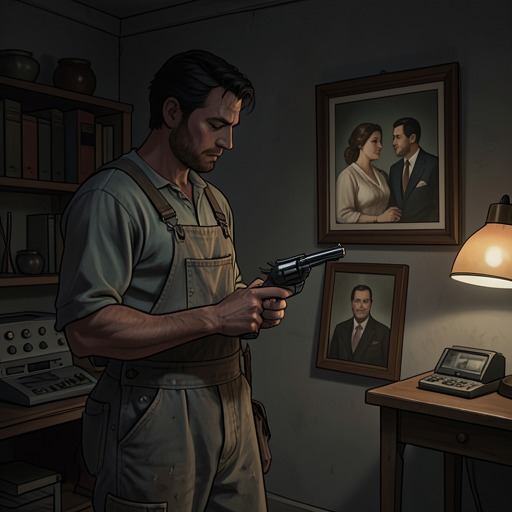
Lee Bodecker destroys the photographic evidence
The Devil All the TimeLee Bodecker destroys the photographic evidence by taking the film from the murder scene, finding Carl Henderson’s hidden collection, and burning the images and canisters at an old dump. The act turns an investigation into a deliberate concealment: the pictures that preserve the victims’ deaths and could help identify the person who killed Carl and Sandy Henderson are erased by the sheriff responsible for pursuing the case.
The photographs and the murders
Carl’s camera was not incidental to his crimes. He used a Leica M3 to draw hitchhikers into staged photographs, presenting the camera and Sandy Henderson’s company as part of an apparently harmless proposition. For Carl, the images gave the killings a second life: he believed the victims’ final moments made the strongest pictures. Sandy, though she participated, resented the camera and understood that it would eventually cost them dearly.
The collection also functioned as Carl’s private record. At home, he kept more than two hundred photographs in a shoebox and revisited them in darkness, trying to guess each image before briefly illuminating it. The ritual carried him through the remembered deaths of twenty-four men. What Bodecker later finds is therefore not merely a set of prints, but an archive of Carl’s crimes and a record of the way he turned murder into an object for repeated viewing.
From the roadside scene to the hidden box
After Carl and Sandy are killed, Bodecker arrives at the car and quietly removes rolls of film from beneath the maps in the open dashboard. He also finds a receipt from a Holiday Inn in Johnson City, Tennessee, and connects it with having seen the couple at a gas station sixteen days earlier. His first actions already compromise the investigation: instead of preserving the film as evidence, he pockets it without the other deputies’ knowledge.
Bodecker reasons from the scene that the person who killed Carl was probably not accustomed to killing, but knew how to handle a gun. The evidence of someone becoming sick after the shooting contributes to that assessment. Later, details he recalls—including a prayer log, dead animals, and a boy with pie juice on his face—bring Arvin Russell back to mind. Bodecker traces a possible route on a map, passing through Johnson City and Lewisburg before following Route 35 into Ohio near Point Pleasant, where Carl and Sandy were killed.
The route does not fit what Sandy had told him about traveling to Virginia Beach, and the couple’s guns raise further questions. Bodecker uses keys taken from Sandy’s key ring to enter the apartment. At first, nothing seems out of place. Then he notices what is missing: Carl, whose life revolved around photography, has left no pictures on the walls or lying about. Searching again with that absence in mind, Bodecker finds the shoebox concealed beneath spare blankets under the bed.
The destruction at Reub Hill
At the old dump on Reub Hill, Bodecker examines the collection before destroying it. He counts photographs of twenty-six different men and estimates that the box holds at least a couple of hundred separate shots, bundled with rubber bands. He places three film canisters with the pictures and uses pages torn from a catalog as kindling. He watches until the prints and film have burned to ashes.
The destruction is deliberate and specific. Bodecker has already withheld film from the roadside scene; now he eliminates the larger collection and the additional canisters he took from the car. The photographs’ scale—dozens of subjects and hundreds of images—makes the loss more than the removal of a single clue. It erases a substantial visual record of the victims and of Carl and Sandy’s method.
Concealment and consequence
Bodecker’s conduct transforms his official investigation into a cover-up. He does not simply overlook the photographs: he recognizes their importance, locates the hidden box by noticing their absence from the apartment, counts the images, and burns both prints and film away from the investigation. The act suppresses evidence that could have documented Carl and Sandy’s crimes and clarified the killings at the roadside.
The episode also gives photography opposed meanings. Carl uses the camera to possess and revisit the victims through images; for Sandy, it is a source of bitterness and an approaching cost. For Arvin Russell, a photograph found in the dead man’s wallet becomes an alarming link to the couple’s crimes, and he takes film from their car before fleeing. Bodecker’s later destruction removes those images from the chain of evidence. The photographs survive in the narrative as objects with consequences even as he ensures that the physical archive does not.